|
|

Main Menu
Home
National
Security News
Ukraine Conflict
Books
Security Information
Homeland Security
Terrorism
Special Operations
Maps
Site Map
Ads
This website is an Amazon Associate
and earns money for qualifying purchases.
Book:
US National Security
https://amzn.to/3ROvaKJ
Mumbai, India
2008 Terrorist Attack
On the evening of November 26, 2008 terrorists struck in a
highly synchronized attack at several locations in Mumbai,
India. This web page provides a brief description of the
attack, links to news articles about the attack in
chronological order, and other Internet resources.
Table of Contents for this Webpage
Description of the Attacks
Past Terrorist Attacks in Mumbai
News Articles About
the Mumbai Attack
News Articles About
Terrorism in India
Websites About the Mumbai
Attacks
Information About Terrorism in
India
Description of the Nov 2008 Mumbai, India Terrorist Attacks
What Happened. At around 10:00 pm on Wednesday, November 28, 2008 in a very well-planned attack on several locations in Mumbai, India, several teams of terrorists attacked targets killing and injuring a large number of people. Although westerners (especially British and United State citizens) were targeted, most of the fatalities were Indian citizens. Some of the targets included a restaurant, Jewish community center, hospital, CST railway station, and two luxury hotels. Hostages were held for a time in two of luxury Mumbai's hotels and a Jewish centre. Some of the terrorists were killed and others were captured. Approximately 195 people were killed, including at least eleven members of the police and security forces and nine foreigners. Many more were injured - numbering in the hundreds - approximately 295. The event lasted about three days with the terrorists finally being dislodged from the Taj Hotel on the final day.
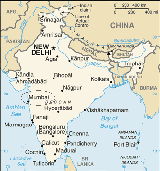
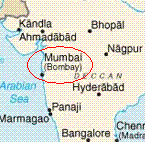
About Mumbai. Mumbai is called the financial capital of India. Mumbai (sometimes called Bombay or Mombay) is a city of 19 million people and a center for tourism and commercialism. Mumbai was a peaceful city but in 1992 Hindu's rioted and killed over 900 Muslims. In 1995 the city was renamed from Bombay to Mumbai. The attacks took place in southern Mumbai in the heart of the tourist district.
Who Are the Terrorists? An organization called the Deccan Mujahideen has claimed responsibility; however, this may be a front name for a much larger, well-known terrorist group. It is quite likely that the terrorists are members of the Lashkar e Toiba (or the self-described Indian Mujaheedin) and/or the Students Islamic Movement of India (SIMI). It appears there were about 15 terrorists involved in the attack. Initial descriptions of the terrorists were that they were masked young men in T-shirts and jeans, heavily armed and carrying backpacks filled with explosives, ammunition, and grenades. There is a lot of speculation that the gunmen may have been from Pakistan and/or Kashmir or at least supported by terrorist groups operating from that country. Two of the terrorists were British citizens of Pakistani origin.
The Victims. The victims were mostly Indian citizens although a number of foreigners were killed to include German (3), French (2), Canadian (1), Australian (1), Singaporean (1), Japanese (1), British, Israeli (5), and American (5) citizens. In total, approximately 23 foreigners were killed including five Americans. Those killed in the Oberoi Hotel included an American father and daughter from Virginia (Alan and Naomi Scherr). They were members of the Synchronicity Foundation. A tribute website has been established for memorialize the Scherr's.
What Were the Terrorists Trying to Accomplish? By striking at the financial center of India, and a place of great tourism significance, the terrorists were probably trying to spread fear to Western tourists and businessmen who travel frequently to Mumbai and also to affect the Indian economy. In the short-term many international firms closed their offices and cancelled travel to Mumbai. The coordinated attack showed high levels of sophistication and planning. One possible reason for the attacks were to chill the relations between Pakistan and India.
The Targets.
Taj Mahal Palace and Tower Hotel. Hostages were held on one of the upper floors and in the ballroom of the Taj Mahal Palace & Tower Hotel. Two explosions on the top floors of the Taj were shown live on Indian TV. The hotel was built in 1903. Approximately 50 deaths here and three terrorists killed.
Oberoi Trident Hotel. Two terrorists were killed at the Oberoi Trident Hotel, The Oberoi's 18th floor was engulfed in flames. Hostages were held for a time on the 19th floor. At least 41 individuals were killed in the Oberoi. Approximately 30 deaths here and two terrorists killed.
Leopold Cafe. This cafe is a restaurant frequented by foreigners and backpackers. A number of people were killed at the Leopold Cafe. More than ten people were shot. This restaurant has been in existence since 1871.
Cama Hospital. Some people were killed in the Cama Hospital.
CST Terminal. This rail station used to be called the Victoria Terminus Train Station but is now called the Chhatrapati Shivaji Terminus. Several people were killed here. The terrorists attacked the main hall of the terminal, then after security arrived, went on to attack the Cama Hospital.
Mumbai Jewish Centre. It appears that the hostages in the Jewish Centre, also called the Nariman House (or Harriman House), were killed during the hostage rescue attempt. The Indian commandos landed on the roof after being transported by helicopter and blew a hole in a outer wall of the building. Eight hostages are known dead to include the rabbi and his wife. The center was owned by the ultra-orthodox Jewish group Chabad Lubavitch. At least one security officer was killed at this location. Two terrorists were killed at this location.
More Information. The terrorists used automatic weapons and hand grenades. The attacks took place mostly in the southern part of the large city. The chief of the Mumbai police anti-terrorism squad was killed while responding to the attacks. Some of the terrorists stole a police jeep and rode through Mumbai shooting at random.
Terrorists Infiltrated Mumbai by Sea. It appears that the terrorists may have infiltrated Mumbai by sea. It is thought that some the attackers infiltrated the Mumbai area of the attacks from the sea possibly on a boat called the Kubar. The boat has been found off the coast with four crew members missing and the captain killed - his hands bound and shot. It is believed the terrorists left the large boat on small inflatable boats. There are several possible reasons for using the sea for entry to include arrival from a foreign country (Pakistan?), an attempt to not have the Mumbai traffic affect the coordinated attacks, and the fact that entry into the city by road or rail is watched by security personnel. Some news reports indicated that they boarded a merchant ship in Karachi, Pakistan that was bound for India. Enroute to Mumbai they hijacked another vessel, killed its captain, and then made their way to Mumbai at which point they left the larger boat and transloaded onto three small rubber boats.
Past Terrorist Attacks in Mumbai
Mumbai has seen terrorist attacks in the past to include attacks that killed hundreds of people in 1993 and 2006. In 2006 the commuter train system was attacked using bombs and over 200 people were killed and about 700 injured.
News Articles About the Mumbai, India Terrorist Attacks
December 21, 2014. "In 2008 Mumbai Attacks, Piles of Spy Data,but an Uncompleted Puzzle", The New York Times. There was lots of intelligence available prior to the event; but it was dispersed among intelligence agencies of Britain, U.S. and India - analysis was lacking.
June 29, 2010. "Bratton says Mumbai attack revolutionized the LAPD". Government Security News.
June 27, 2010. "Mumbai Night Mare not for Too Long, Hotels Have Tightened Up All Security Measures!" Business Travel Tips.
May 3, 2010. "Pakistani Man Convicted in 2008 Mumbai Attacks". The New York Times.
January 15, 2010. "4 indicted in Mumbai, Denmark Terror plots". CNN News.
January 15, 2010. "US charges three men over 2008 Mumbai attacks". BBC News.
November 26, 2009. "Pakistan charges 7 suspects in Mumbai attacks". Yahoo! News.
December 11, 2008. "Attacks Raise Concerns On Hotel Guest Security". The Transnational.
November 29, 2008. "Pakistani Militants At Center of Probe". The Washington Post.
November 29, 2008. "Analysis: Bad Intel Aided Attacks". Sky News.
November 29, 2008. "Mumbai attacks could chill India-Pakistan ties". Los Angeles Times.
November 29, 2008. "Focus on abandoned boat as Mumbai siege ends". CNN Asia News.
November 29, 2008. "Last Gunmen Killed in India, Ending Siege". The Washington Post.
November 29, 2008. "Hollow victory as more bodies discovered in Jewish centre and top hotels". Times Online.
November 29, 2008. "Couple Killed in Mumbai Were Revered in Brooklyn". The Washington Post.
November 29, 2008. "Virginians Slain in Attacks Lived Out Peaceful Ideals". The Washington Post.
November 28, 2008. "Mumbai attacks: India accused of bungling anti-terror operations". Telegraph.
November 28, 2008. "Backgrounder: Counterterrorism in India". Newsweek.com.
November 28, 2008. "Sporadic Gunfire, Bomb Blasts as Mumbai Siege Continues". VOA News.
November 28, 2008. "Timeline: Two Days of Terror". The New York Times.
November 28, 2008. "The Political Price of Terrorism". Forbers.com.
November 28, 2008. "U.S. Intelligence Focuses on Pakistani Group". The New York Times.
November 28, 2008. "Americans Are Among the Dead in Mumbai Terrorist Attacks". U.S. News and World Report.
November 28, 2008. "Hostages dead at Mumbai Jewish centre, reports say". The Guardian.
November 28, 2008. "Sophisticated Attacks, but by Whom?" The New York Times.
November 28, 2008. "Mumbai: Twitter's Moment". Forbes.com.
November 28, 2008. "India blames 'elements' in Pakistan for attacks". The Washington Post.
November 28, 2008. "In Mumbai, terrorists and survivors sought". The Los Angeles Times.
November 28, 2008. "My Bombay No More". A novelist mourns Mumbai's fate. Forbes.com.
November 28, 2008. "Indian Stocks, Rupee Drop as Terrorist Attacks Hurt Confidence". Bloomberg.com.
November 28, 2008. "Indian Commandos Battle Assailants". The Washington Post.
November 27, 2008. "Attack forces India onto front lines of global war on terror". USA Today.
November 27, 2008. "At Least 100 Dead in India Terror Attacks". The New York Times.
November 27, 2008. "Mumbai Markets Poised For Fall". Forbes.com.
November 27, 2008. "US condemns terrorist attacks in India". Associated Press.
November 27, 2008. "Mumbai Attacks Put Hotel Safety in Question". The Wall Street Journal.
November 27, 2008. "Indian commandos battle to regain Mumbai hotels". National Post.
November 27, 2008. "Mumbai Notebook: Squeeze to India's Cash-Strapped Carriers". The Wall Street Journal.
November 27, 2008. "Warden Message: Terror Attacks in Mumbai". Overseas Security Advisory Council (OSAC).
November 27, 2008. "Mumbai terror attacks: travel advice". The Guardian.
November 27, 2008. "Dozens Die in Mumbai Attacks". The Washington Post.
November 27, 2008. "Al Qaeda just one suspect in India terrorist attacks". The Los Angeles Times.
November 27, 2008. "India Under Terrorist Siege". Forbes.com.
November 27, 2008. "Mumbai attacks: Who are the Deccan Mujahideen?" NP Posted.
November 27, 2008. "Foreigners targeted in co-ordinated Bombay attacks". The Times Online.
November 27, 2008. "Attacks to Set Back Mumbai's Financial Ambitions". The Wall Street Journal.
November 27, 2008. "Indian forces storm Jewish centre". BBC News.
November 27, 2008. "Former U.N. Ambassador Bolton on Terror Attacks in India". Fox News.
November 27, 2008. "Gunfire heard at two Mumbai hotels". CNN News Asia.
November 27, 2008. "Terrorists Strategically Picked Mumbai". NPR.com.
November 27, 2008. "Attacks Leave Mumbai Reeling". Forbes.com.
November 27, 2008. "Mumbai Mourns After Deadly Terror Attack". VOA News.
November 26, 2008. "Who are the Deccan Mujahideen?" Foreign Policy Passport.
November 26, 2008. "A 'Planned' Operation Designed to Create Chaos". By Walid Phares, The Fox Forum.
November 26, 2008. "Making sense of India's terrorist attacks". Newsweek.com.
November 26, 2008. "India's financial capital under terror siege". The Long War Journal.
November 26, 2008. "Wave of Terror Attacks Strikes India's Mumbai, Killing at Least 82". Fox News.
November 26, 2008. "At Least 78 Dead In Terrorist Attacks In Mumbai". NPR.org.
News Articles About Terrorism in India
November 26, 2008. "Recent Attacks on Americans or American Interests in India". Fox News.
September 23, 2008. "Terrorism's Impact Grows as Indian Election Nears". The New York Times.
September 14, 2008. "Explosions at 5 Sites in India's Capital Kill 18". The New York Times.
July 28, 2008. "Facing a Wave of Violence, India is Rattled". The New York Times.
July 27, 2008. "At Least 45 Killed in Explosions in India". The New York Times.
Websites About the Mumbai Terror Attacks
The Mumbai Terror Attacks. The Guardian World News.
Maps of Mumbai Attack Sites. By BBC News.
Witness Accounts of Mumbai Attacks. CNN News.
Twitter Search for Mumbai. See postings on Twitter about Mumbai.
U.S. Embassy Statement on Mumbai Attack. Issued November 27, 2008.
Travel Advisory for India and Warden Messages. By U.S. Embassy in India.
U.S. Consulate General in Mumbai, India.
Graphic of the Attack. Depicts locations on map of Mumbai. Los Angeles Times.
Information About Terrorism in India
There are numerous terrorist groups in India and many of them are anti-Western. These include Harkat-ul-Jihad-i-Islami, Jaish-e-Mohammed, Lashkar-e Tayyiba, and Harakat ul-Mujahidin. A source of discontent spawning terrorist groups is the tenuous state of Kashmir - of which both India and Pakistan claim as part of their country.
11 July 2006 Mumbai Train Bombings. Wikipedia, the free encyclopedia.
Lashkar-i-Tayyaba. A description of the South Asian terrorist group provided by Wikipedia.
Collection of Articles about Terrorism in India. By The Counterterrorism Blog.
India - Terrorist, insurgent and extremist groups. By the South Asia Terrorism Portal.
Terror Groups in India. By the Council on Foreign Relations (CFR).
Designation of Lashkar e-Tayyiba (LET) as terrorist organization. Press release by U.S. Department of State.
Travel Advisory for India. By New Zealand Government.
Terrorism in India. By The New York Times. A history of and breaking news on terrorism in India. A listing of past NYTs articles on terrorism in India.
General Information about Mumbai and India
CIA World Factbook on India. Geography, people, government, economy, communications, transportation, military, and other topics.
India 2008 Crime & Safety Report: Mumbai. Overseas Security Advisory Council (OSAC).
Consular Information Sheet for India. U.S. Department of State.
Background Notes for India. U.S. Department of State.
A Country Study: India. By the Federal Research Division, Library of Congress.
US Commercial Service for India. BUYUSA.GOV.
India. By the Washington Post.
India Travel Information and Travel Guide. The Lonely Planet.
|
|
Books on National Security and Defense

https://bookshop.org/lists/national-security-and-defense
We are an affiliate of Bookshop.org and will earn a small commission if you click through and make a purchase.