|
|

Main Menu
Home
National
Security News
Ukraine Conflict
Books
Security Information
Homeland Security
Terrorism
Special Operations
Maps
Site Map
Ads
This website is an Amazon Associate
and earns money for qualifying purchases.
Book:
US National Security
https://amzn.to/3ROvaKJ
Strait of Hormuz
The Strait of Hormuz is a narrow waterway that lies between Iran and Oman. This important waterway is a transit point for roughly 20% of global seaborne oil trade from Saudi Arabia, United Arab Emirates, Iraq, Iran, and Qatar.
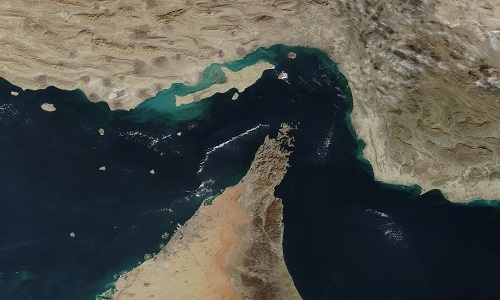
Map: Strait of Hormuz, NASA, 10 Dec 2018
Click for larger image:
Image of Strait of Hormuz, .
The Strait of Hormuz is one of the most strategically significant maritime chokepoints in the world, connecting the Persian Gulf to the Gulf of Oman and ultimately the Arabian Sea. The strait lies between Iran to the north and Oman and the United Arab Emirates to the south. At its narrowest point, the strait is approximately 21 miles (34 km) wide, with designated shipping lanes only 2 miles wide in each direction, making it highly vulnerable to disruption through mining, missile strikes, drone attacks, or naval interdiction.
During the initial days of the Iran War of 2026, Iran blocked the strait - prohibiting vessels from passing through. By the end of March 2026, it was selectively allowing vessels to pass through the strait - depending on which nation the vessels were flagged under. Iran also began charging a "toll" for ships to pass through the strait.
The closing of the strait during the Iran War has driven up the price of oil and gas as well as other commodities. The financial markets suffered as well. There was a dramatic rise in insurance rates for ships.
Timeline for Strait of Hormuz
April 12, 2026. The United States announced that the U.S. Naval will impose a naval blockade on the Strait that will stop vessels that pay an "illegal toll" to Iran for passage. This naval blockade was implemented hours after the Iranians turned down the U.S. offer at the ceasefire conference held in Islamabad, Pakistan on April 11, 2026.
April 8, 2026. Iran announces that the strait is closed due to violations by Israel of the ceasefire agreement.
April 7, 2026. The ceasefire agreement between the United States and Iran provides for the immediate reopening of the strait to commercial vessels.
March 31, 2026. Trump indicated that re-opening the strait was no longer a U.S. priority and that Europe could take on that task. (Truth Social statement 20260331) The strait remains a "high-risk" zone and U.S. gas prices surpass $4 a gallon. Throughput through the strait is less than 10% of historical levels. Some "non-hostile" ships (Chinese and Malaysian) have been allowed to pass after paying fees of up to $2 million. If the closure persists the Brent crude price could move toward $190 per barrel. According to @TankerTrackers.com, Inc. only 84 tankers have departed the Middle East region via the Strait of Hormuz. Less than 3 tankers a day.
March 30, 2026. President Trump said he would obliterate power plants, desalination lants, and oil wells if the strait is not opened up. An Iranian parliamentary committee approved a plan to impose tolls on ships crossing the strait. The plan would also formally ban American and Israeli vessels.
March 30, 2026. The Department of State issues a listing of four war aims; re-opening the Strait of Hormuz is not one of them.
March 24, 2026. About 2,000 paratroopers from the 82nd Airborne Division are ordered to the Middle East; most likely with the intention to reopen the strait, to take Kharq Island, or to serve as a reaction / contingency force.
March 23, 2026. The President said the U.S. could jointly control the strait with the leader of Iran.
March 22, 2026. President Trump said he would "obliterate" Iranian power plants if Iran did not re-open the strait.
March 19, 2026. U.S. Armed Forces begin a campaign to reopen the strait by forces.
March 14, 2026. President Trump ordered the 31st Marine Expeditionary Unit (MEU) and an amphibious task force to sail from Japan to the CENTCOM AOR to help re-open the Strait of Hormuz.
March 10-20, 2026. U.S. intelligence reports Iran has begun mining the waterway. President Trump demands their immediate removal and the U.S. military detroys 16 minelayers.
March 4-9, 2026. Iran claims complete control over the strait. It announces that only "friendly" vessels (primarily Chinese) can pass. It prohibits ships bound for the U.S. or Israel.
March 2, 2026. Major shipping firms (Maersk, CMA CGM, Hapag-Lloyd) suspend transits of the strait.
March 1, 2026. Shortly after the beginning of the bombing campaign by the U.S. and Israel, Iran closed the Strait of Hormuz to vessel traffic. Iran declared the strait closed to "unfriendly nations". Since the beginning of March at lest 21 confirmed attacks on merchant ships were reported by mid-March with the use of naval drones and aerial drones. Electronic warfare took place with widespread jamming of GPS signals affecting over 1,000 ships in the Persian Gulf. Insurance companies cancelled or significantly increased insurance premiums.
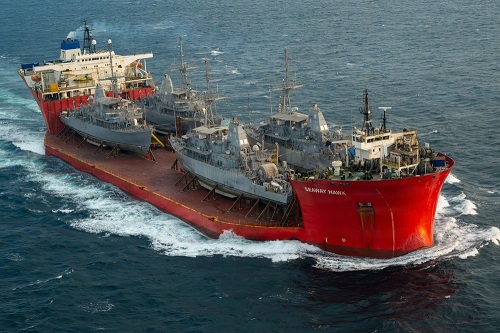
Photo: The merchant vessel Seaway Hawk sails in the Arabian Gulf in January 2026 while transporting decommissioned U.S. Navy Avenger-class Mine Countermeasures Ships, USS Devastator, USS Dextrous, USS Gladiator and USS Sentry. (U.S. Navy photo by Mass Communication Specialist 2nd Class Iain Page, Jan 20, 2026)
Avenger-class Mine Countermeasures Ship
In January 2026, the U.S. Navy sent four Avenger-class mine countermeasures ships home to the U.S. to be scrapped. The four mine sweepers had been based in the Persian Gulf for the last thirty years. The Avengers were replaced by three littoral combat ships (LCS) that have a minesweeping package. These three LCSs are homeported in Bahrain. As of March 2026, in the midst of the Iran War, one of these was in the Indian Ocean and the other two were in Malaysia.
References
2026 Strait of Hormuz Crisis - Wikipedia
https://en.wikipedia.org/wiki/2026_Strait_of_Hormuz_crisis
August 7, 2026, The Strait of Hormuz: Security Developments and Impacts on Oil, Gas, and Other Commodities, CRS R45281, PDF, 21 pages. This report examines how the Iran conflict and Tehran’s disruption of Strait of Hormuz shipping threaten global energy and commodity markets. It highlights reduced maritime traffic, rising oil and gas prices, Iran’s military capabilities, and congressional considerations involving naval escorts, insurance, and federal emergency responses. https://www.congress.gov/crs-product/R45281
April 10, 2026, The Strait of Hormuz in Brief: Non-Oil Shipments and Effects on Shippers, CRS R48903. https://www.congress.gov/crs-product/R48903
March 11, 2026, Iran Conflict and the Strait of Hormuz:
Impacts on Oil, Gas, and Other Commodities, Congressional
Research Service, CRS R45281.6, PDF, 19 pages.
https://www.congress.gov/crs_external_products/R/PDF/R45281/R45281.6.pdf
News Reports on Strait of Hormuz
April 13, 2026, "A Closed Strait of Hormuz Risks a Global Food Security Crisis", War on the Rocks.
April 8, 2026, "Continuing Crisis in Strait of Hormuz: Why Iran's Hold is Illegal and U.S. Military Force Alone Fails", by Mark Nevitt, Just Security.
March 27, 2026, "Reopen the Strait of Hormuz? There's one big problem", by Alexander Wooley, The Washington Post. This article provides a brief history of sea mines in the Persian Gulf.
March 26, 2026, "Iran's Mine Threat to the Strait of Hormuz", by Hollie McKay and Oliver Guitta, National Interest. Iran has an estimated 5,000 to 6,000 sea mines available to place in the Strait of Hormuz. While the U.S. and other nations have mine clearance capabilities, the time and effort required to clear thousands of inexpensive sea mines is significant.
March 17, 2026. The navy is lacking the mine sweeping capability it needs to keep the Strait of Hormuz open. "The Mine Gap: America Forgot How to Sweep the Sea", Foreign Policy Research Institute.
March 16, 2026, "The US has several options to counter Iranian mines. These are some key assets", by Riley Ceder, Navy Times.
External Sources
Iran -
SOF News Maps
Map, Strait of Hormuz, CIA 1980 (click for larger image)
|
Books on National Security and Defense

https://bookshop.org/lists/national-security-and-defense
We are an affiliate of Bookshop.org and will earn a small commission if you click through and make a purchase.