|
|

Main Menu
Home
National
Security News
Ukraine Conflict
Books
Security Information
Homeland Security
Terrorism
Special Operations
Maps
Site Map
Ads
This website is an Amazon Associate
and earns money for qualifying purchases.
Book:
US National Security
https://amzn.to/3ROvaKJ
MQ-58 Valkyrie CCA Drone
Home > Weapons > Drones > MQ-58
The MQ-58 Valkyrie Collaborative Combat Aircraft Drone is being fielded to the Marine Corps. The intent of the MQ-58 is to pair it with F-35s as part of a family of next-generation air combat capabilities.
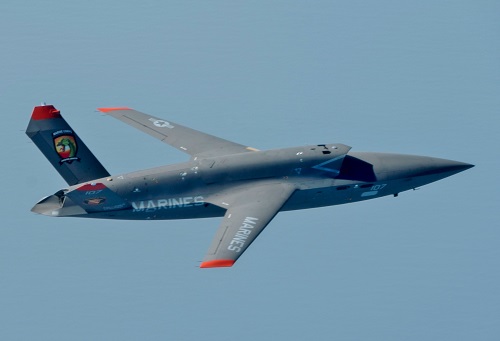
Photo: A U.S. Marine Corps XQ-58A Valkyrie, highly autonomous, low-cost tactical unmanned air vehicle, soars overhead during its first test flight at Eglin Air Force Base, Fla., Oct. 3, 2023.
The MQ-58 Valkyrie is a low-cost, runway-independent unmanned combat aerial vehicle (UCAV) developed by Kratos Defense & Security Solutions as part of the U.S. Air Force’s Skyborg program and now central to the emerging Collaborative Combat Aircraft (CCA) concept. Designed to operate as a “loyal wingman,” the Valkyrie is intended to team with crewed fighters such as the F-35 Lightning II and F-22 Raptor, extending their reach, survivability, and lethality in contested environments.
A defining feature of the MQ-58 is its affordability and attritability. Unlike exquisite fifth-generation fighters, the Valkyrie is built to be relatively inexpensive—often cited in the low millions per unit—allowing commanders to accept higher risk in high-threat environments. Its design supports launch via rocket-assisted takeoff from austere locations and recovery by parachute, eliminating reliance on traditional runways and enhancing operational flexibility in dispersed or denied theaters.
Technically, the Valkyrie combines a low observable (stealthy) airframe with a modular payload architecture. It can carry a mix of sensors, electronic warfare packages, and precision munitions internally, preserving its radar cross-section. The aircraft’s range—estimated at over 2,000 nautical miles—enables deep penetration missions such as intelligence, surveillance, and reconnaissance (ISR), strike, and electronic attack. Its open systems architecture is intended to facilitate rapid integration of new technologies, particularly autonomy software.
Autonomy is the core enabler of the CCA concept. Through ongoing development under programs like Skyborg, the MQ-58 is evolving toward increasingly sophisticated levels of onboard decision-making, allowing it to operate semi-independently or in coordinated swarms. In practice, a single pilot in a crewed aircraft could command multiple Valkyries, delegating tasks such as forward sensing, decoy operations, or weapons employment. This human-machine teaming model aims to complicate adversary targeting cycles and increase combat mass without proportionally increasing pilot workload or risk.
Strategically, the MQ-58 Valkyrie reflects a broader shift in airpower toward distributed, networked, and cost-imposing force design. As near-peer competitors field advanced air defenses and long-range fires, platforms like the Valkyrie offer a scalable way to project power while preserving high-value manned assets. In this context, the MQ-58 is less a standalone system than a foundational element of future air combat ecosystems.
References
"First USMC MQ-58 Valkyrie CCA Drones to Arrive in 2029", by Thomas Newdick, The War Zone, April 26, 2026.
"Marine Corps Experimental 'Loyal Wingman' Drone Makes First Flight", U.S. Naval Institute, October 5, 2023.
|
|
Books on National Security and Defense

https://bookshop.org/lists/national-security-and-defense
We are an affiliate of Bookshop.org and will earn a small commission if you click through and make a purchase.